


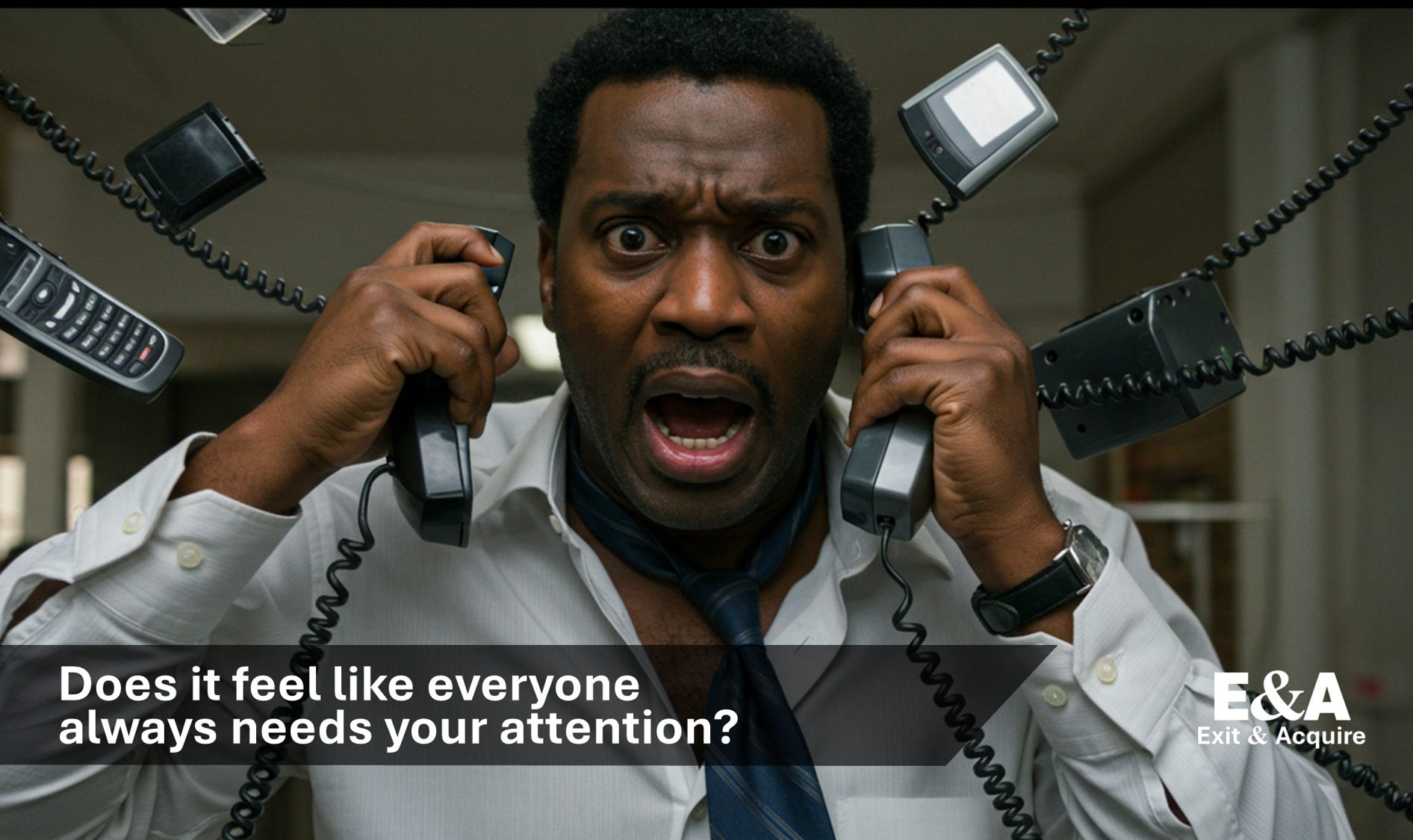
It starts with a simple ping.
Then a text.
Then a Slack message.
A “quick call” that’s never quick.
By 10:00 a.m., your calendar looks like a crime scene of commitments. And somewhere between solving everyone else’s fires, you forget what you were supposed to be building.
I had a founder tell me once, “I feel like I’m running a daycare for adults.” He wasn’t being cruel. He was exhausted. His people needed him, his customers needed him, his investors needed him. Every day was an endless loop of decisions, approvals, and interruptions. He was the bottleneck, and the business was quietly suffocating under the weight of his attention.
When I looked at his deal readiness, it was clear: the company’s enterprise value plateaued, not because the market wasn’t there, but because he’d trained everyone to depend on him. In the eyes of a buyer, that dependency was risk.
When everyone needs your attention, what you really lose is valuation.
This is the hidden tax of leadership. It doesn’t show up on your P&L, but it bleeds your time, your judgment, and your capacity for deep work. The irony is that the more successful you become, the more people compete for your attention.
And the less time you have to do the thinking that success really requires.
Attention isn’t just a psychological concept. It’s an economic one. In M&A, we price risk. A business that is overly dependent on the owner’s decisions is less transferable, less scalable, and far less appealing to acquirers. The founder’s constant availability becomes a liability, not a virtue.
So how do you reverse it?
One founders I met, a second-generation manufacturer, made a radical shift. He stopped being “available” and started being “intentional.” Meetings were limited to one 90-minute window each day. Decision rights were distributed to team leads. Slack notifications were turned off entirely during focus hours. Within 90 days, the results were undeniable: throughput improved, turnover dropped, and for the first time, the owner could take a week off without a single crisis call.
That’s not just operational improvement; that’s value creation. A business that runs without you is a business that can be sold.
Protecting your attention isn’t selfish…It’s the most strategic move you can make to multiply enterprise value.
The founder who masters this art doesn’t just run a smoother company. They create leverage. They build a brand that scales. They make room for foresight, creativity, and the kind of strategic depth that fuels high-quality deals.
Attention, after all, is the wellspring of judgment. Without it, you react. With it, you design.
When I’m advising a seller preparing for market, one of the first questions I ask is, “If you took a vacation in Fiji for 90 days without your phone and your computer, would your business still grow?” The answer reveals almost everything about readiness, valuation, and transferability.
Most say no.
But the rare ones who say yes? Those are the ones that exit for life-changing multiples.
There’s a lesson in that for all of us. You can spend your days being needed.
Or you can build something that doesn’t need you.
One path leads to burnout. The other leads to freedom.
So I’ll ask you this:
When was the last time you protected your own attention like it was the most valuable asset you own?
David Hermann, CEO of hermanngroup and M&A Advisor/Broker at Sunbelt Business Brokers of Colorado
David Hermann is a transformative advisor and strategist who turns complex business challenges into extraordinary successes. Known for driving over $500 million in documented financial improvements for clients, David partners with C-suite leaders to unlock their full potential. With 60+ speaking engagements, numerous publications, and a spot in the top 1% of Consulting Voices and top 1% of the Social Selling Index on LinkedIn, he’s passionate about making strategy, change leadership, and operations insightful and accessible.