


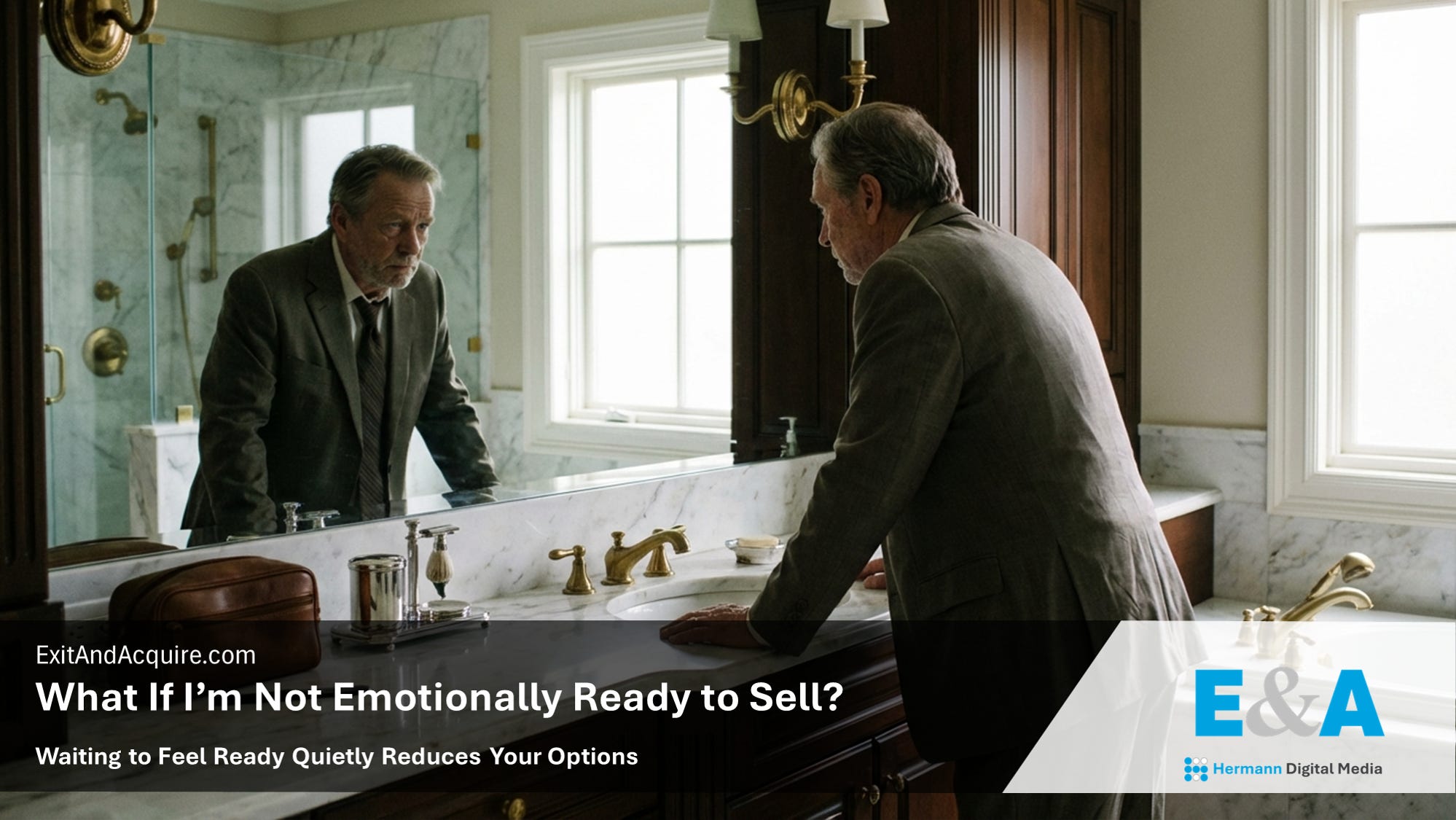
A founder sat across from me not long ago and said, “I know I should probably sell, but I’m not ready.”
Revenue had flattened.
Margins were tightening.
A key employee had quietly started owning more strategic relationships.
The business was still solid, but the slope had changed.
What he meant by “not ready” wasn’t operational.
It was personal.
He didn’t know who he would be without the business.
This comes up more often than people admit. Owners assume readiness is a financial or market-based decision. Buyers assume sellers come to market when the timing is right.
Neither is true.
Emotional readiness is often the gating factor, and it rarely lines up with market readiness.
If you are not emotionally ready, the market will still move without you.
From an advisory perspective, this makes sense. Founders build identity, community, and control into their businesses over decades. Selling is not just a transaction. It is a separation event. It forces a redefinition of purpose, routine, and status. That is not something most people resolve on a spreadsheet.
But from a broker and buyer perspective, this misalignment creates risk.
Buyers are not evaluating your emotional state. They are evaluating durability, transferability, and trajectory. If they sense hesitation, it shows up as friction in diligence, slower responses, second-guessing on terms, or a last-minute shift in expectations.
That friction gets priced.
Sometimes explicitly through retrades. More often implicitly through reduced urgency or a narrower buyer pool. Sophisticated buyers have seen this before. They recognize when an owner is testing the idea of selling versus committing to it.
The difference matters.
An owner who is not emotionally ready tends to behave in ways that erode leverage without realizing it. They delay decisions. They hold out for terms they have not fully thought through. They send mixed signals about their willingness to transition or stay involved.
Buyers respond by protecting themselves.
They add structure. They stretch timelines. They look for concessions. Or they walk.
What most owners miss is the second-order effect. It is not just about whether a deal closes. It is about what kind of deal becomes available to you.
When you are emotionally aligned with the decision to sell, you tend to run a tighter process. You communicate more clearly. You make faster, cleaner decisions. That increases competitive tension and preserves optionality.
When you are not, the process becomes reactive. You start negotiating with yourself in real time, and the buyer can feel it.
There is a reasonable counterargument here. Some owners believe they can use a market process to “see what’s out there” and decide later.
In limited cases, that can work.
But it is riskier than it sounds.
Going to market is not a neutral act. It creates signaling. Employees notice changes. Customers pick up on subtle shifts. Buyers invest time and expect seriousness. If you pull back late because you are not ready, you do not return to a clean slate.
You return with a story attached.
I have seen owners lose their best window because they needed another year to get comfortable with the idea of selling. That year often changes the business more than expected. A contract rolls off. A key person leaves. Market conditions shift.
The option they thought they were preserving quietly degrades.
The core issue is not whether you feel ready. It is whether you understand the cost of waiting for that feeling to arrive.
In most cases, emotional readiness does not appear suddenly. It is built deliberately.
That might mean separating identity from the business over time. It might mean defining what comes next before you initiate a process. It might mean pressure-testing what you actually need from a deal beyond price.
Those are advisory questions, not brokerage steps.
By the time you are in a live process, the market expects clarity. If you are still working through what selling means to you, you are doing it in the most expensive environment possible.
The practical implication is straightforward.
You do not need to rush into a sale. But you do need to treat emotional readiness as part of exit preparation, not something that will resolve itself once offers show up.
Because by then, the market is no longer waiting for you to decide.
It is deciding how much risk you represent.
Crack the code.
The Change Agent Code is now available on Amazon

David Hermann, CEO of hermanngroup and M&A Advisor and Licensed Broker at Sunbelt Business Brokers of Colorado
David Hermann is the advisor founders call when the stakes are real.
As CEO of HermannGroup and an M&A Advisor and Licensed Broker with Sunbelt Business Brokers of Colorado, he helps owners turn complex businesses into valuable, sellable assets and navigate exits without regret. His work has driven over $500M in documented financial improvements, blending strategy, change leadership, and deal execution into decisions that actually compound.
If you’re thinking about growth, transition, or exit, you’re already late to the conversation.
I reserve limited time each week for private conversations to ensure they remain thoughtful, confidential, and useful.
If you want to pressure-test your thinking around an exit or acquisition, request a private conversation here.