


A founder called me recently after twenty-two years in business.
Revenue was steady.
The company had good customers, a loyal team, and a recognizable name in its niche.
From the outside, it looked like a success story.
But the owner was exhausted.
Growth had stopped five years earlier.
Not declining. Just… stuck.
He assumed the next move was obvious: sell.
When we started walking through the numbers and the structure of the business, a different reality emerged.
Buyers would see a plateau, not a peak.
The company still depended heavily on the founder for decisions and relationships.
Documentation was thin.
The management bench was narrow.
In buyer language, the company was stable but fragile.
The owner had unknowingly reached a very specific stage in the founder lifecycle: Stall.
Most founders believe the path looks like this.
Start a business. Grow it. Sell it. Move on.
The market rarely works that way.
In practice, the lifecycle usually looks more like:
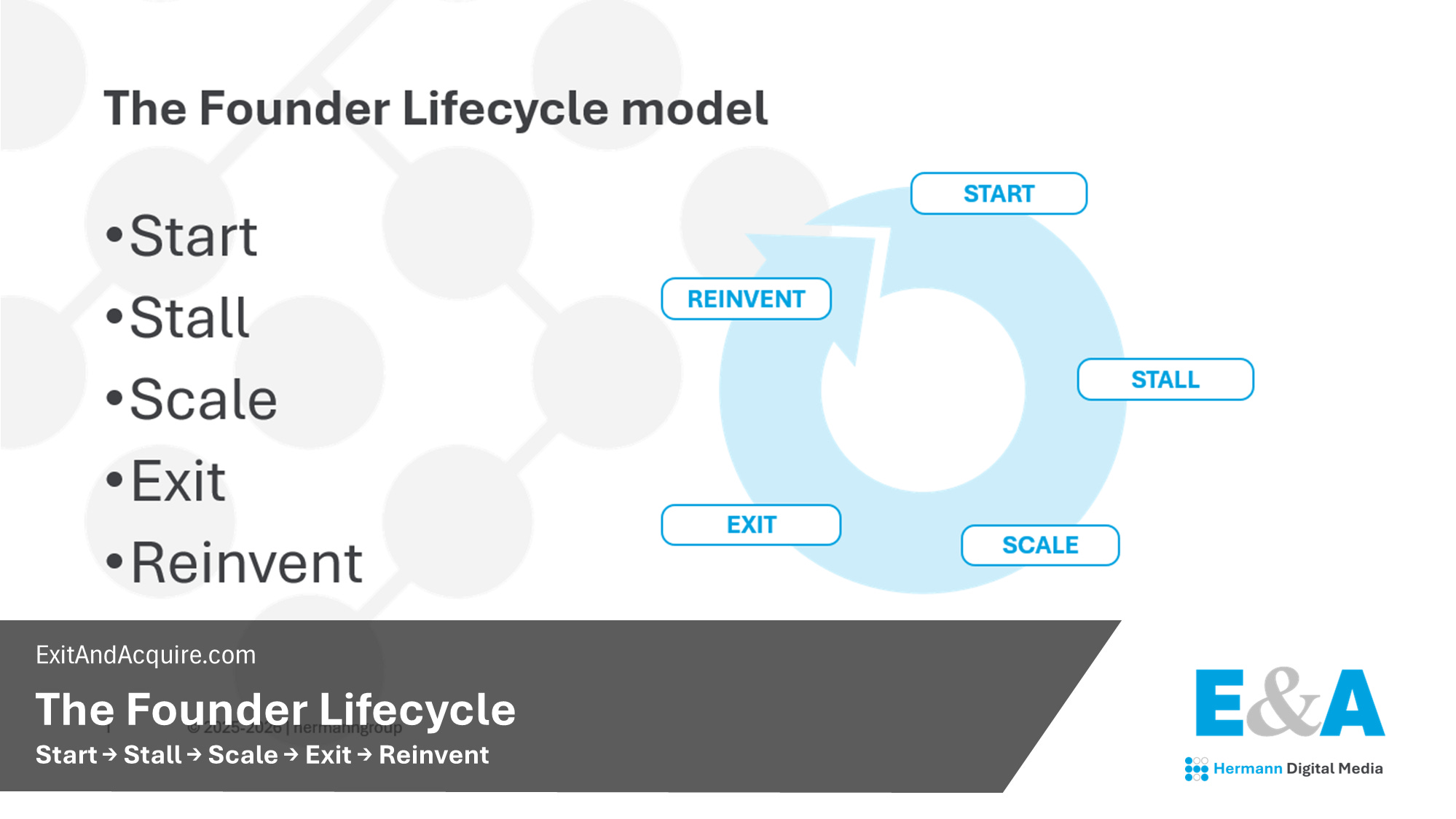
Start → Stall → Scale → Exit → Reinvent.
The “stall” phase is the least discussed and the most consequential.
The phase you believe you are in is often not the phase buyers see.
In advisory work, this is where founders begin to feel the weight of the company they created. Decisions concentrate around them. Every operational issue eventually lands on their desk. Growth slows not because the market disappears, but because the organization cannot expand beyond the founder’s bandwidth.
From the owner’s perspective, the company still feels valuable. It produces income. It has history and relationships.
From a buyer’s perspective, the signals are different.
Plateaued growth raises questions.
Founder-centric decisions create transfer risk.
Informal systems make due diligence slower and more uncertain.
Buyers discount their offer price based upon uncertainty.
This is where the lifecycle branches.
Some founders push through the stall and build the next stage: scale.
Scaling is not simply selling more. It means the business begins to function independently of the founder’s constant intervention. Decision authority spreads across the organization. Systems replace improvisation. Growth becomes repeatable rather than heroic.
From a buyer’s perspective, this is where valuation starts to expand.
Risk moves away from the individual and into the structure of the company.
But not every founder wants to scale.
Some are ready to exit once the business reaches stability. Others discover that they enjoy building more than operating.
That realization leads to a different stage: reinvention.
After a sale, some founders retire comfortably. Many do not. They start something new, invest, or step into advisory roles. The energy that built the first company rarely disappears.
What most founders underestimate is how much timing inside this lifecycle affects leverage.
Selling during a stall usually means the buyer prices the work still required to scale the business. Waiting until the company demonstrates scalable systems shifts that economics in the seller’s favor.
The market rewards durability.
There are reasonable counterarguments to this framework. Some founders intentionally build “lifestyle businesses” that are never meant to scale or sell. Others operate in industries where growth is naturally capped by geography or regulation.
But, those businesses can sell successfully, too.
However, even there, buyers are evaluating the same fundamental question: how easily can the company continue operating without the founder.
The lifecycle is less about ambition than about transferability.
Founders tend to think about their businesses in terms of effort and identity. Buyers think in terms of risk and continuity.
Those perspectives eventually have to meet.
When they do, the stage of the lifecycle becomes very clear.
Crack the code.
The Change Agent Code is now available on Amazon

David Hermann, CEO of hermanngroup and M&A Advisor and Licensed Broker at Sunbelt Business Brokers of Colorado
David Hermann is the advisor founders call when the stakes are real.
As CEO of HermannGroup and an M&A Advisor and Licensed Broker with Sunbelt Business Brokers of Colorado, he helps owners turn complex businesses into valuable, sellable assets and navigate exits without regret. His work has driven over $500M in documented financial improvements, blending strategy, change leadership, and deal execution into decisions that actually compound.
If you’re thinking about growth, transition, or exit, you’re already late to the conversation.
I reserve limited time each week for private conversations to ensure they remain thoughtful, confidential, and useful.
If you want to pressure-test your thinking around an exit or acquisition, request a private conversation here.