


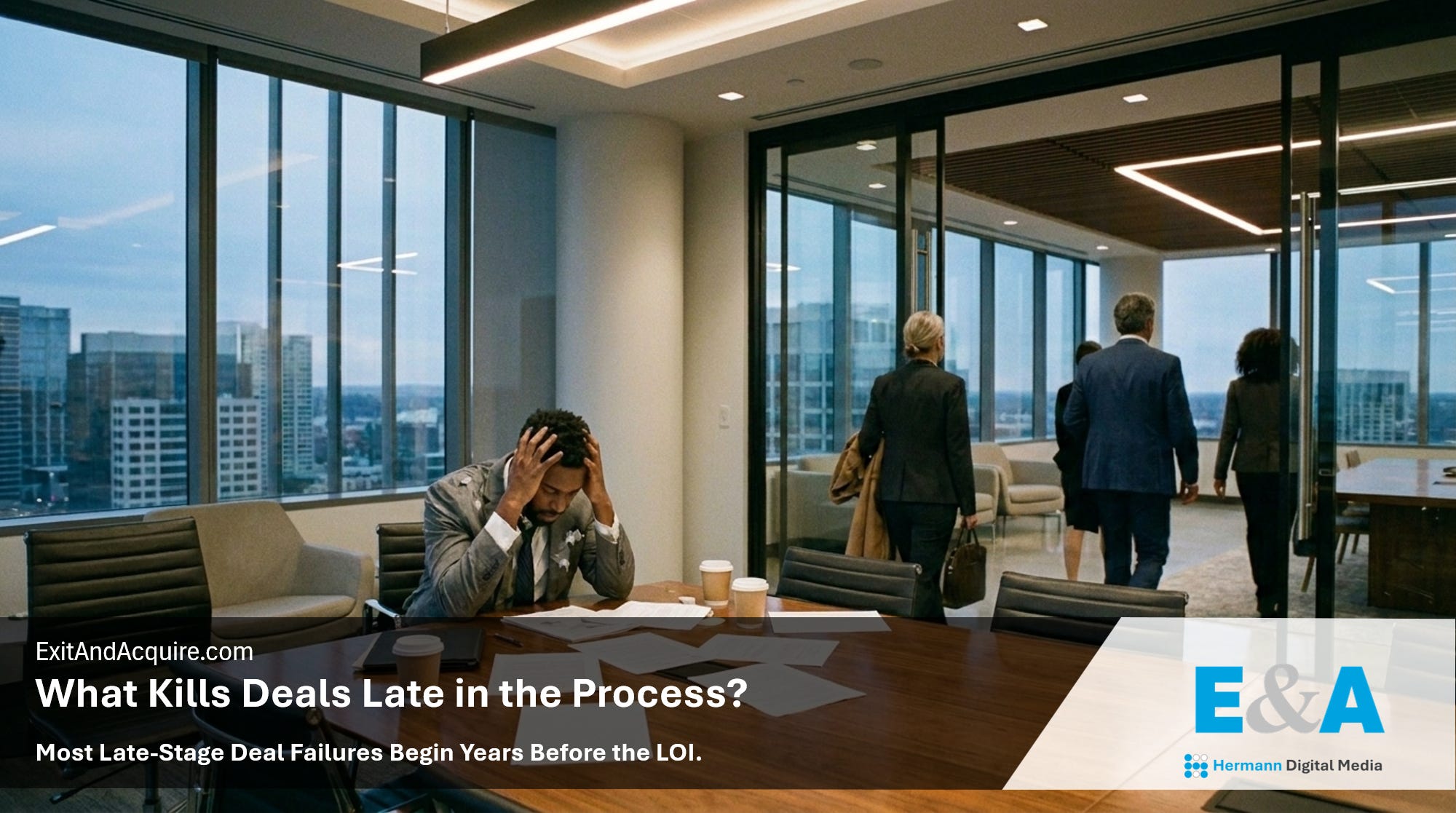
Most owners think deals die because of price.
Late-stage deals usually die because trust collapses faster than the buyer expected it could.
The pattern is remarkably consistent. A business goes to market. Interest is strong. Meetings go well. The owner feels validated because buyers seem enthusiastic and the valuation range is better than expected. LOIs arrive. Due diligence begins.
Then the process changes tone.
Questions become narrower. Response times slow down. The buyer starts asking for explanations instead of information. Attorneys get pulled in earlier. Quality of earnings concerns appear. Key employee dependencies suddenly matter more than they did three weeks earlier.
The owner often interprets this as negotiation theater.
Sometimes it is. Most of the time it is not.
Buyers do not become more pessimistic during diligence because they enjoy conflict. They become more conservative because diligence changes the type of risk they are underwriting. Early in the process, they are buying a story. Late in the process, they are buying consequences of the sellers’ business decisions.
That distinction matters more than most owners realize.
In the advisory work I do, owners frequently believe the transaction is effectively done once the LOI is signed. Emotionally, they begin spending the money before diligence even starts. Mentally, they shift from proving the business to defending it.
That is usually where leverage begins to erode.
A buyer can tolerate imperfections. Most experienced buyers actually expect them. What they struggle to tolerate is discovering that management either did not understand the problem or hoped the problem would remain undiscovered.
Those are two very different signals.
A customer concentration issue may not kill a deal. But discovering the seller understated it in conversation often will.
Messy financials may not kill a deal. But realizing the owner cannot reconcile operational reality with reported numbers changes the buyer’s perception of execution risk.
An outdated ERP system may not kill a deal. But learning that institutional knowledge exists almost entirely inside the owner’s head materially changes transition assumptions.
The issue is rarely the issue itself.
The issue is what the issue implies.
That is the part many owners underestimate.
Buyers price businesses partly on historical performance, but they structure deals around future uncertainty. During diligence, small inconsistencies compound because buyers start asking themselves second-order questions.
If reporting is inconsistent, what else is inconsistent?
If margins shifted unexpectedly, how stable are customer relationships?
If key employees seem disengaged, what happens after ownership changes?
If the owner avoids difficult questions, what other surprises remain undiscovered?
Those questions affect financing, earnout structures, working capital targets, indemnification language, and ultimately whether the buyer still believes the original valuation was justified.
Late-stage deal failure usually begins long before diligence starts.
The market often mis-frames this as a documentation problem. Documentation matters, but most failed deals are really credibility failures disguised as process failures.
I have seen owners spend months trying to maximize headline valuation while ignoring the operational friction that quietly destroys buyer confidence. Then, during diligence, the buyer recalibrates risk faster than the seller recalibrates expectations.
That gap becomes expensive.
Sometimes the deal dies outright. More commonly, the seller absorbs the damage through retrading. Purchase price reductions, larger holdbacks, seller financing requirements, longer transition periods, or more aggressive earnout terms start appearing because the buyer no longer believes the business transfers as cleanly as initially presented.
Owners often interpret this as unfairness.
From the buyer’s side, it usually feels rational.
A reasonable counterargument is that some buyers weaponize diligence intentionally. That absolutely happens. Certain buyers use late-stage pressure to force concessions after emotional commitment has formed. Experienced sellers should recognize that possibility.
But weak preparation creates the opening.
Sophisticated buyers generally do not expect perfection. They expect coherence. They want the numbers, operational realities, management behavior, and growth narrative to align closely enough that future surprises appear containable.
When they do not, buyers start protecting themselves.
That protection shows up financially first and emotionally second.
The irony is that many late-stage deal problems are visible years earlier. Founder dependency. Weak reporting discipline. Deferred maintenance. Informal processes. Customer overconcentration. Unclear management accountability. These issues rarely emerge suddenly during diligence. Diligence simply removes the seller’s ability to narrate around them.
That is why strong exit preparation is not really about preparing for a transaction.
It is about reducing the number of future explanations the business will require once scrutiny becomes unavoidable.
Crack the code.
The Change Agent Code is now available on Amazon

David Hermann, CEO of hermanngroup and M&A Advisor and Licensed Broker at Sunbelt Business Brokers of Colorado
David Hermann is the advisor founders call when the stakes are real.
As CEO of HermannGroup and an M&A Advisor and Licensed Broker with Sunbelt Business Brokers of Colorado, he helps owners turn complex businesses into valuable, sellable assets and navigate exits without regret. His work has driven over $500M in documented financial improvements, blending strategy, change leadership, and deal execution into decisions that actually compound.
If you’re thinking about growth, transition, or exit, you’re already late to the conversation.
I reserve limited time each week for private conversations to ensure they remain thoughtful, confidential, and useful.
If you want to pressure-test your thinking around an exit or acquisition, request a private conversation here.